
Start a range of sublimation blank items with the products you can print consistently and the customers you already serve. For a 2026 assortment, start with a 30 oz flip-straw tumbler, then add a few distinct formats such as a dual-sip bottle, a trucker cap or a coated aluminum photo panel. Each has its own print surface, equipment requirements and packing costs. A small first order gives you a way to measure how the blanks behave before you stock more sizes or styles.
This guide is for print shops, gift distributors and retailers buying undecorated items in bulk. It covers which blanks to shortlist, what to check on samples and what to put in your request for a quote.
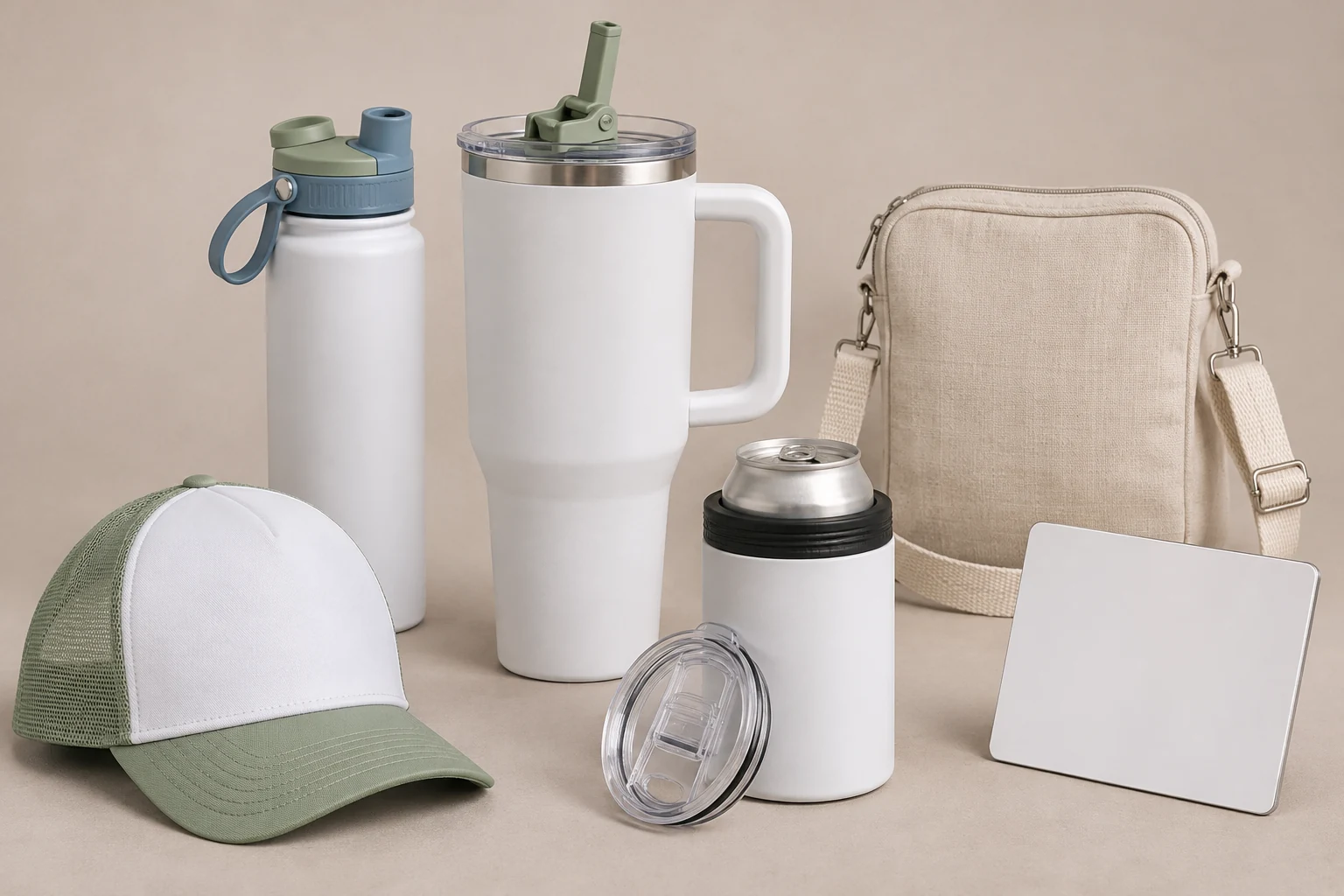
Table of Contents
Match the blank to your equipment
Ask what the ink will actually bond to. For conventional dye sublimation, a compatible light-colored polyester textile is a common starting point. A ceramic mug needs a surface prepared for sublimation. A linen-look cover may be printable, but its texture and appearance tell you little about the actual fiber content. Ask for the material specification for the exact face you will print. Epson’s dye-sublimation guide explains what to look for in fabric and coated hard goods.
Measure the usable area of your press and the blank’s finished shape. For a tapered tumbler, ask for a wrap template and check which lid and handle parts the supplier recommends removing before pressing. For a mug, check body diameter, straight-sided print height and clearance near the handle. On a sewn item, check where seams, pocket edges and binding sit against the platen. A large outside dimension can still leave a small flat print panel.
Compare blanks by customer and print area
Flip-straw lids and carry-friendly bottles reflect a broader focus on how drinkware is used, a theme at the 2026 ASI Chicago show. The 2026 sublimation lookbook from GRAPHICS PRO also highlights linen-look bags, printable caps and metal photo panels. For a resort shop, try a can cooler and cap with the same destination artwork. For school or club orders, pair a sports bottle with a cap.
| Blank item | Good starting use | Check before ordering |
|---|---|---|
| 30 oz flip-straw sublimation tumbler | Event merchandise and branded gifts | Check taper and handle clearance, then test the wrap seam and lid seal on a sample. |
| 24 oz dual-sip sublimation sports bottle | Schools, teams and outdoor events | Confirm that both the straw and direct-drink openings work and check the coated print height below the lid. |
| 12 oz two-in-one sublimation can cooler | Resort shops, beach events and beverage promotions | Confirm can diameter and check that both the retaining collar and drinking lid fit. |
| Linen-look sublimation crossbody bag | Travel gifts, markets and boutique merchandise | Verify the printable face is sublimation-compatible and measure the flat area around the zipper and seams. |
| Sublimation trucker cap | Team shops, festivals and resort merchandise | Specify a printable polyester front panel and test the artwork on your cap press. |
| Coated aluminum photo panel | Photography gifts, awards and team displays | Confirm the coated face, finish and flat-press fit. Check edge protection in the carton. |
| Coated mugs | Photo and logo gifts | Confirm coating, press fit and the usable area around the handle. |
| Cushion covers | Photo gifts or reading-themed sets | Measure the printable panel. Check the pocket on a filled cover and quote inserts separately. |
| Pot holders | Printed kitchen gift ranges | Measure inside the binding. Review the intended use and any required performance evidence for the finished pad. |
| Hooded baby towels | Personalized baby gifts | Check whether the hood or body is printable and confirm labeling and buyer requirements for the destination. |
| Neck gaiters and arm sleeves | Clubs and sports events | Check fit, stretch, artwork orientation and whether quantities are counted in pieces or pairs. |
For more formats to test, compare our heart-shaped bamboo photo frame blanks, MDF LOVE photo panel blanks and elevated pet bed blanks with removable covers. For seasonal printing, see the linen-look Christmas stocking options.
Run a small print trial before buying bulk
Use the design you expect to sell. Include fine text, a solid color and a pale tone so you can spot unclear edges, uneven transfer or an unwanted base-color cast. Keep an unprinted sample next to the printed one to compare the material before and after pressing. Record the press model, ink, transfer paper, temperature, time and pressure.
Sawgrass’s heat-press chart gives starting settings and advises testing on suitable substrates. Ask for the settings recommended for the selected blank, then establish your own repeatable result. For more on coated drinkware, see our blank mug sample checklist.
- Compare two or more samples of the same blank to see whether the print position and finish repeat.
- Measure a sewn item before and after pressing, then check any parts that could mark the print area.
- For a washable textile, use the intended care instructions to see how the artwork, seams and dimensions hold up on the sample.
- Keep the approved blank and printed sample with the supplier’s model or material reference.
Compare cost per usable blank
A lower carton price can be offset by breakage, press rejects or extra preparation time. Ask for units per carton, gross weight and carton dimensions. Quote mugs with their protective packing. Quote flat covers and gaiters by unit count and ask about the extra carton volume if inserts or retail boxes are included.
For an internal comparison, divide the estimated landed cost by the number of blanks you expect to receive and print successfully. For example, if a shipment costs $240 landed and a planning estimate is 114 usable blanks, the estimated cost is about $2.11 per usable blank before ink, paper, labor and retail packing. Use your own sample results and shipment experience to refine the estimate.
What to send for a bulk quotation
- Product and size, printable face or coating, base color and the artwork area you need.
- Press type and usable dimensions, intended print workflow and sample quantity.
- Units by style and color. Clarify piece, pair, cover-only or set quantities.
- Unit packing, destination, required arrival date and any buyer-specific test or label requirements.
If you’re comparing multiple suppliers, use the same specifications and pack requirements in each inquiry. Our RFQ checklist for custom products covers the rest of the brief.
Frequently asked questions
Can any white item be sublimated?
Ask what the printable face is made from. A white textile and a white ceramic mug can both look suitable while requiring very different substrates and equipment.
Can we order different blanks together?
Ask for minimum quantities and samples by model first. Once the mix is defined, compare consolidated packing and shipment costs. Keep fragile and soft items in the packing arrangements approved for each.
What should I check when reordering?
Use the approved sample and supplier reference. Confirm any changes to the fabric, coating, dimensions or packing, and run a new print trial when those details change.
Asia Supply Source can help compare samples and prepare a bulk sourcing brief. Send your shortlist, press type, quantities and delivery destination so we can assess the blanks and packing together.